Biblical Counseling Curriculum
Some of the most common things I hear from people who have gone through biblical counseling training is: “What do I do next?” “Where do I start?” “I don’t feel fully prepared.” The Hub Resource is intended to give you the confidence to help others identify, uncover, and work through the source of their struggles, with the deep truths of God’s Word, in a practical and relevant way.
I see biblical counseling as a three-lane highway that must be wisely navigated by the counselor. Biblical counseling is helping others apply the Word of God to their struggles and issues in life. The Word of God serves as the central lane in the counseling process. It represents the biblical principles, truths, and wisdom that inform and shape the counseling approach, visualized in the theology of the cross, shown here. Biblical counseling seeks to understand and apply the teachings of Scripture to address the challenges and concerns individuals face through recognizing biblical authority, biblical truths, and the desire for spiritual growth. This is represented in this curriculum. I propose we allow this curriculum to guide us along the journey with each of our counselees.
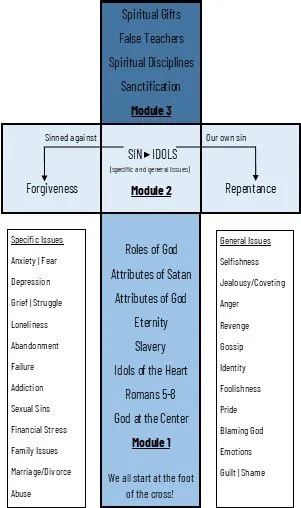
The other lanes represent the Specific Issues—the challenges, and struggles individuals bring to counseling—as well as the General Issues that will be uncovered as we work through the counseling process. (These two lanes are shown alongside the cross.) We acknowledge that people come with unique circumstances, emotions, experiences, and relational dynamics that need to be understood and addressed in a compassionate and practical way. These two lanes recognize the importance of understanding individuals' specific contexts, histories, and personal factors that contribute to their challenges. We consider psychological, physical, emotional, social, and relational aspects of their lives. We then focus on applying the biblical principles and truths from the central lane to the practical needs and concerns of our counselees. We aim to provide guidance, support, and practical strategies from the Word to help our counselees navigate their specific challenges. We weave their specific and general issues into our weekly studies and conversations.
In biblical counseling and discipleship relationships, our aim is to guide others toward the foot of the cross as we address our struggles and issues in light of theology. The Hub Resource equips us with the knowledge of the Word and helps us share its truth with those we influence, whether through a formal biblical-counseling relationship, intentional discipleship, or our daily interactions. As we work our way up the cross, through Module 1, we acknowledge the sovereignty of God as we bring our will into alignment with His. We understand sin and Satan cause chaos in our lives leading to various idols that enslave us and keep us from an abundant life. In Module 2, the horizontal portion of the cross, we admit that our own sin requires repentance while being sinned against requires forgiveness, both which require the tremendous grace and mercy of God. Once our minds are renewed, and we are freed from the bondage of our past, in Module 3 we explore true sanctification, devotion, and service as we live lives of worship and holiness before the Lord. Having weaved all of the idols of the heart into a thorough system of theology, we can now experience the real and lasting hope and healing for which we all long.
Throughout this curriculum, we identify and work to eliminate the idols of the heart. An idol is anything or anyone that replaces God’s rightful place in our heart. We, as well as our counselees, all have different idols we worship, in part represented by our specific and general issues. Though they will differ for each of us and for each of our counselees, the objective is always the same—to make God bigger and our idols smaller—eventually choking out our idols all together. Through the renewing of our minds and the putting off of our slavery to our idols and putting on righteousness and holiness, we help our counselee find victory and freedom over their issues and struggles. Again, the issues/idols will differ for each person but the objective is always the same. Our goal is to “convince” our counselees through the Word of God that God is deserving and capable of filling every part of our heart and life and that our idols are a sorry replacement for the One True God.
How do we handle a counselee’s past? Our counselees will fall on a broad spectrum of how deeply they have been affected and continue to be affected by their past. This also requires tremendous wisdom as a counselor to consider the past without obsessing on the past and to acknowledge the past without giving the past excessive power in our counselee’s life today. As represented in this picture of the cross, in order to find hope and healing, we will be helping our counselees identify the sin in their own life that requires repentance, and the possible need to ask others that they have harmed for forgiveness. We will also be helping our counselees identify, from their past, those who have sinned against them that they need to work to extend forgiveness.
This curriculum is not intended to be a cookie-cutter approach. I like to define wisdom as the perfect balance on a pendulum. We often times swing one way or the other. In this case, I personally believe it’s beneficial and helpful to provide counselors with a curriculum to follow, especially those who are just starting out or who are intimidated by the thought of where to start. I believe to not allow for this swings to one side of the pendulum. But we definitely don’t want to swing to the other extreme where we rely on the curriculum to replace our time of preparation in the Word and dependance on the Holy Spirit to guide and direct our counseling. I suggest you study this material diligently, like you would any other biblical-counseling training, being sure you understand it deeply yourself and are confident to guide your counselees. You also must be willing to adjust as needed.
One thing to consider is that not everyone will be at the same place in their understanding of God’s Word. For example, I currently have one counselee who I don’t even provide a worksheet to help guide him through his weekly homework. I tell him the topic to study, and this young man comes back the next week with a 30-minutes sermon that is better than many people hear each Sunday in their local church! : ) I currently work with a couple others who are younger in their faith. Growth for them involves working through the guided homework worksheets and coming up with a few principles of what God has taught them. I spend more time teaching and guiding the conversations in these cases. I also differ in the amount of homework I give, depending on perceived capacity. If I start them off slowly, and they prove faithful with little, I will bless them with much! ; )
Sometimes, we will spend 90% of a session discussing theology, and other times we will spend 80% of our time talking and praying about a specific struggle or issues that came up that week. Again, this requires wisdom. Referring back to the pendulum, we don’t want to spend all of our time on theology—aloof, unaware, uncaring, and treating every person the same—nor do we want to spend all of our time discussing issues and struggles over and over with no real solutions. We want to find that perfect balance of compassion and care, theology and truth, and masterfully weaving these lanes together.
There is also nothing magical about 15-16 weeks. This just provides an outline to guide us through the counseling process. Again, wisdom is required in how quickly or deliberately we move through each counseling case. In their excellent book “Counseling the Hard Cases” by Stuart Scott and Heath Lambert, it was not uncommon for a counseling case to extend over an entire year, though this should be the exception not the norm.
Together, we can make this curriculum even stronger. I would encourage you to join the Hub Community which is a place where you can connect with other like-minded individuals who are engaged in biblical counseling. You will have the opportunity to participate in online discussions, receive mentoring and coaching, ask questions, share your own insights and experiences, and pray with and for each other and those we counsel. Our passion is to motivate and mobilize all Christians to wisely and effectively counsel those God brings into our lives.
CURRICULUM (for Believers); see below for detailed itinerary
Week 1: Introductory Session: What are the issues and how can we help? Inner man and outer man
Week 2: God at the Center: Gospel walkthrough from Genesis to Revelation; Believer or unbeliever?
Week 3: Romans 5-8: Death vs life; law vs grace; old man vs new man; slavery vs freedom; flesh vs Spirit; condemnation vs justification and reconciliation; despair vs hope
Week 4: Idols of the Heart: We were created to be worshippers. An idol is anything or anyone that captures our hearts, minds, and affections more than God.
Week 5: Returning to Egypt/Slavery: It is for freedom that Christ has set us free. Let us not return to slavery.
Week 6: Eternity: Life is a vapor; eternity is forever. Cost-Benefit Analysis
Week 7: Names and Attributes of God: Does God deserve our worship? Does He deserve every place in our heart?
Week 8: Names and Attributes of Satan: We have a real enemy who hates us and who steals, kills, and destroys. His goal is to enslave us all over again. Compare his attributes to those of God!
Week 9: The Roles of God the Father/Jesus Christ/Holy Spirit in our Lives: How the three Persons of the Godhead are active in our justification, sanctification, and glorification
Week 10: Sin/Repentance/Forgiveness Tour: How do we understand repentance both before and after salvation? Do we have any unrepentant sin? From whom do we need to seek forgiveness?
Week 11: Past/Forgiveness/Reconciliation Tour: Who has hurt us from our past? What does it mean to extend forgiveness and pursue peace and reconciliation with those people? Do they deserve our forgiveness?
Week 12: Sanctification/Fruit: What is past, present, and future sanctification? What does it look like to pursue holiness as He is holy? What is the significance of a fruitful life?
Week 13: Spiritual Disciplines: What are they? What are their benefits? How do we practice the disciplines out of freedom and not obligation?
Week 14: False Teachers: What are common false teachings today? How do we identify and avoid false teachers and teachings?
Week 15: Spiritual Gifts: What gifts has God granted us? How do we use these gifts to serve Him and His Church?
CURRICULUM (for unbelievers)—starting homework: have them read through the Gospel of John over the first three weeks
Week 1: Introductory Session: What are the issues and how can we help? Inner man and outer man
Week 2: God at the Center: Gospel walkthrough from Genesis to Revelation; Believer or unbeliever?
Week 3: Gospel: Build on the previous week, seeking true understanding of the complete Gospel and its benefits.
Week 4: Eternity: Life is a vapor; eternity is forever. Cost-Benefit Analysis
Week 5: Names and Attributes of God: Does God deserve our worship? Does He deserve the central place in our heart?
Week 6: Names and Attributes of Satan: We have a real enemy who hates us and who steals, kills, and destroys. His goal is to enslave us. Compare his attributes to those of God!
Week 7: The Roles of God the Father/Jesus Christ/Holy Spirit in our Lives: How the three Persons of the Godhead are active in our salvation
At this point, by the grace of God, the counselee will have surrendered their life to Christ, and you will continue on through the curriculum, immersing them in the Word of God. If they are unwilling to surrender to Christ, you will need to make a determination if you will continue with your counselee. Moving forward, if they are not willing to acknowledge that the Word of God is sufficient to bring hope and healing to their situation, biblical counseling really can’t be of benefit to them.
Week 8: Romans 5-8: Death vs life; law vs grace; old man vs new man; slavery vs freedom; flesh vs Spirit; condemnation vs justification and reconciliation; despair vs hope
Week 9: Idols of the Heart: We were created to be worshippers. An idol is anything or anyone that captures our hearts, minds, and affections more than God.
Week 10: Returning to Egypt/Slavery: It is for freedom that Christ has set us free. Let us not return to slavery.
Week 11: Sin/Repentance/Forgiveness Tour: How do we understand repentance both before and after salvation? Do we have any unrepentant sin? From whom do we need to seek forgiveness?
Week 12: Past/Forgiveness/Reconciliation Tour: Who has hurt us from our past? What does it mean to extend forgiveness and pursue peace and reconciliation with those people? Do they deserve our forgiveness?
Week 13: Sanctification/Fruit: What is past, present, and future sanctification? What does it look like to pursue holiness as He is holy? What is the significance of a fruitful life?
Week 14: Spiritual Disciplines: What are they? What are their benefits? How do we practice the disciplines out of freedom and not obligation?
Week 15: False Teachers: What are common false teachings today? How do we identify and avoid false teachers and teachings?
Week 16: Spiritual Gifts: What gifts has God granted us? How do we use these gifts to serve Him and His Church?
WEEKLY SESSIONS—Curriculum for Believers (the order is slightly different when working with an unbeliever—adjust as necessary); the phrases in quotes are what you are saying to them.
Week 1: Introductory Session
Pray
Introductions
Go over the Personal Data Inventory
Bible study:
Explain to them the inner man and outer man and how they work together
Homework:
“Buy a journal or create a digital journal.”
“Pray every day that God will prepare your heart for biblical counseling and do the work only He can do in your life.”
“Schedule three one-hour recurring time slots into your calendar to spend on homework.”
“Buy ‘Gospel Treason’ by Brad Bigney”
“Come prepared to share the Gospel with me next week from Genesis to Revelation. If you need help, just reach out, and I will give you clues, like you would ask for when stuck in an escape room.” (If you feel like this is too much for them to take on this week, just walk through the Gospel with them next week.)
Prayer requests (Record these; keep a running list; pray for your counselee(s) regularly.)
Prayer (Have them pray first if they are comfortable.)
Week 2: God at the Center
Pray
“Are there any updates or have you had any struggles from the week?”
“Is there anything you would like to start our time talking about this week?”
Review homework:
“Did you buy or create a journal that we will use in our time together?”
“How was your prayer time this past week about this journey?”
“Were you able to schedule three one-hour recurring time slot into your calendar to spend on homework?”
“Did you buy ‘Gospel Treason’ by Brad Bigney?”
Bible study
“If you were to die right now and be face to face with God, what would be your reason for Him letting you into Heaven?”
“Explain the full Gospel to me, from Genesis 1 to Revelation 22.”
Work through this with them, filling in gaps they will inevitably miss.
Determine, based on that interaction and to the best of your knowledge, whether you think they are a Believer or unbeliever.
Homework:
Making the connection: “Now that we have a thorough understanding of the redemption narrative, we’ll look more deeply this coming week at the fundamental aspects of the Christian faith, such as justification, reconciliation, the role of the Holy Spirit, and the victorious life we now have in Christ.”
“Complete the worksheet: "‘Romans 5-8.’”
“Read as much of ‘Gospel Treason’ as you have the capacity for.”
“Memorize Proverbs 3:5-7.”
“Pray and ask God to help you understand and apply the principles of Romans 5-8 to your life.”
Other:
“Come prepared to teach Romans 5-8 and what you learned from ‘Gospel Treason.’”
Prayer requests (Record these; keep a running list; pray for your counselee(s) regularly.)
Prayer (Have them pray first if they are comfortable.)
Week 3: Romans 5-8
Pray
“Are there any updates or have you had any struggles from the week?”
“Is there anything you would like to start our time talking about this week?”
Tie their specific issue(s)/struggle(s)/idols into the topic this week whenever possible to make the study as relevant as possible for them.
Review homework:
“How was your prayer time this past week?”
“How did the homework go overall?”
“Did you memorize Proverbs 3:5-7?”
Bible study:
Teach me what you learned from Romans 5-8? (Open your Bibles together.)
Make this a conversation, filling in any gaps in their understanding.
Teach me what you learned from “Gospel Treason.”
Making the connection: “Now that we have a thorough understanding of the redemption narrative and the fundamental aspects of the Christian faith, such as justification, reconciliation, the role of the Holy Spirit, and the victorious life we now have in Christ, we’ll identify the idols of our hearts this coming week.”
Introduce idol worship for next week.
Homework:
“Complete the worksheet: ‘Idol Worship.’”
“Fill out the “Idols of the Heart” sheet.”
Explain that God: the Father, Son, and Holy Spirit go in the center!
Define idols: “Anything or anyone that takes God's rightful place in our hearts can be an idol: these can be ‘good things’ like hobbies, a spouse, etc. or ‘bad things’ like blatant sin, worry, doubt, lack of trust, etc. Take some time to pray and meditate on the idols in your heart. Come up with your best list at this point in time. Be honest with yourself before God.”
“Our goal over the next several weeks is to make God bigger in our hearts and lives and our idols smaller.”
“Read ‘Gospel Treason.’”
“Memorize Jeremiah 17:5-10.”
“Pray and ask God to help you uncover and identify the idols of your heart.”
“Come prepared to teach next week about Idol Worship and ‘Gospel Treason.’”
Prayer requests (Record these; keep a running list; pray for your counselee(s) regularly.)
Prayer (Have them pray first if they are comfortable.)
Week 4: Idols of the Heart
Pray
“Are there any updates or have you had any struggles from the week?”
“Is there anything you would like to start our time talking about this week?”
Tie their specific issue(s)/struggle(s)/idols into the topic this week whenever possible to make the study as relevant as possible for them.
Review homework:
“How was your prayer and bible study time this past week?”
“Did you memorize Jeremiah 17:5-10?”
Bible study
“Teach me what you learned about idol worship.”
Make this a conversation, filling in any gaps in their understanding.
“Teach me what you learned from ‘Gospel Treason.’”
Here is the link to the “Gospel Treason—Study Guide”:
“From the ‘Idols of the Heart’ sheet, share with me the idols that were exposed in your heart and the context of each. Are some more deeply rooted than others?”
Ask them and their spouse (if relevant) if any of these came as a surprise to them.
If this is marriage counseling, ask each spouse how the other’s idols affect them and how that plays out in their marriage.
If this is marriage counseling, meet with the husband and wife separately for a few minutes and ask if there are any sins they were not willing to bring up with their spouse present.
Record these; add to them as other idols surface in the coming weeks.
Making the connection: “Now that we’ve identified some of your idols, we’ll look at how these idols, though some of them may appear harmless, enslave us to our former way of life and keep us from the freedom God intends.”
Introduce slavery for next week.
Homework:
“Complete the worksheet: ‘Slavery.’”
Have them start reading a new book from the “Recommended Counselee Reading List.”
“Memorize Romans 12:1-2.”
“Pray and ask God to help the desires of your heart and to make your life a living sacrifice.”
Other: “What is your purpose? Do you have a life and/or family mission statement. Start thinking about phrases that describe this. You will be writing out a life mission statement or slogan. Come with some proposals if you would like and we can work on it together.”
Make sure you have worked on this yourself first.
Prayer requests (Record these; keep a running list; pray for your counselee(s) regularly.)
Prayer (Have them pray first if they are comfortable.)
Week 5: Returning to Egypt/Slavery
Pray
“Are there any updates or have you had any struggles from the week?”
“How are you doing with your idols? What are some practical steps you can take to start making God bigger and your idols smaller?”
“Is there anything you would like to start our time talking about this week?”
Tie their specific issue(s)/struggle(s)/idols into the topic this week whenever possible to make the study as relevant as possible for them.
Review homework:
“How was your prayer and bible study time this past week?”
“Did you memorize Romans 12:1-2?”
“Have you started thinking about a life mission statement?”
Bible study
“Teach me what you learned about slavery.”
Make this a conversation, filling in any gaps in their understanding.
“How does this relate to the idols in your heart?”
“Teach me what you learned from ______ (book).”
Making the connection: “Now that we’ve identified how foolish it is to return to the things that enslave us, we will now look at all of the benefits that lie in store for those of us who follow the Lord and reject our idols.”
Introduce eternity for next week.
Homework:
“Complete worksheet: ‘Eternal Rewards.’”
“Continue to read ______ (book).”
“Memorize Galatians 2:20.”
“Pray and ask God to give you a heart for Him and to want to obey. Praise Him for His good gifts.”
Other: “Complete the ‘Cost-Benefit Analysis’ sheet; explain the four quadrants.” Instruct them that the “Future” quadrants should include both our earthly futures and eternal futures.
Prayer requests (Record these; keep a running list; pray for your counselee(s) regularly.)
Prayer (Have them pray first if they are comfortable.)
Week 6: Eternity
Pray
“Are there any updates or have you had any struggles from the week?”
“How are you doing with your idols? What are some practical steps you are taking to start making God bigger and your idols smaller?”
“Is there anything you would like to start our time talking about this week?”
Tie their specific issue(s)/struggle(s)/idols into the topic this week whenever possible to make the study as relevant as possible for them.
Continue to think through a life mission statement with them.
Review homework:
“How was your prayer and bible study time this past week?”
“How have you been doing in sticking to the time slots you set for homework? Do you need to make any adjustments?”
“Did you memorize Galatians 2:20?”
Bible study
“Teach me what you learned about eternity.”
Make this a conversation, filling in any gaps in their understanding.
“Walk me through your Cost-Benefit Analysis.”
Make this a conversation, filling in any gaps in their understanding.
“Teach me what you learned from ______ (book).”
Making the connection: “We will now look at the names and attributes of God and determine whether God deserves a bigger place in our hearts.”
Introduce the names and attributes of God for next week
Homework:
“Complete the worksheet: Names and Attributes of God.’”
“Continue to read or start reading ______ (book).”
“Memorize John 10:10.”
“Pray and magnify the Lord for who He is!”
Prayer requests (Record these; keep a running list; pray for your counselee(s) regularly.)
Prayer (Have them pray first.)
Week 7: Names and Attributes of God
Pray
“Are there any updates or have you had any struggles from the week?”
“How are you doing with your idols? What are some practical steps you are taking to start making God bigger and your idols smaller?”
“Is there anything you would like to start our time talking about this week?”
Tie their specific issue(s)/struggle(s)/idols into the topic this week whenever possible to make the study as relevant as possible for them.
Continue to think through a life mission statement with them.
Review homework:
“How was your prayer and bible study time this past week?”
“Did you memorize John 10:10?”
Bible study
Teach me what you learned about God’s names and attributes.
Make this a conversation, filling in any gaps in their understanding.
“Teach me what you learned from _______(book).”
Making the connection: “We will now look at the names and attributes of Satan to better understand our real enemy and who we are choosing to serve in giving credence to our idols.”
Introduce names and attributes of Satan for next week.
Homework:
“Complete the worksheet: ‘Names and Attributes of Satan.’”
“Continue to read or start reading ______ (book).”
“Catch up on/review the previous memory verses.”
“Pray and ask God to give you the ability to resist Satan, sin, and the flesh.”
Prayer requests (Record these; keep a running list; pray for your counselee(s) regularly.)
Prayer (Have them pray first.)
Week 8: Names and Attributes of Satan
Pray
“Are there any updates or have you had any struggles from the week?”
“How are you doing with your idols? What are some practical steps you are taking to start making God bigger and your idols smaller?”
“Is there anything you would like to start our time talking about this week?”
Tie their specific issue(s)/struggle(s)/idols into the topic this week whenever possible to make the study as relevant as possible for them.
Continue to think through a life mission statement with them.
Review homework:
“How was your prayer and bible study time this past week?”
“How did memorization review go?”
Bible study
“Teach me what you learned about Satan.”
Make this a conversation, filling in any gaps in their understanding.
“Teach me what you learned from _______(book).”
Making the connection: “We will now look at the role each person of the Godhead plays in our life to gain a deeper appreciation of this God we serve and to gain a better understanding of how each relates to our salvation and sanctification.”
Introduce the roles of God the Father/Jesus Christ/Holy Spirit in our lives
Homework:
“Complete the worksheet: ‘Roles of the Father, Son, and Holy Spirit.’”
“Continue to read or start reading ______ (book).”
“Memorize Mark 12:30-31”
“Pray and meditate on the amazing attributes of God and how they manifest themselves in your life.”
Prayer requests (Record these; keep a running list; pray for your counselee(s) regularly.)
Prayer (Have them pray first.)
Week 9: The Roles of God the Father/Jesus Christ/Holy Spirit in our Lives
Pray
“Are there any updates or have you had any struggles from the week?”
“How are you doing with your idols? What are some practical steps you are taking to start making God bigger and your idols smaller?”
“Is there anything you would like to start our time talking about this week?”
Tie their specific issue(s)/struggle(s)/idols into the topic this week whenever possible to make the study as relevant as possible for them.
Continue to think through a life mission statement with them.
Review homework:
“How was your prayer and bible study time this past week?”
“Did you memorize Mark 12:30-31?”
Bible study
“Teach me what you learned about the roles of the Godhead.”
Make this a conversation, filling in any gaps in their understanding.
“Teach me what you learned from _______(book).”
Making the connection: “Now that we know that God rightfully deserves every place in our heart and that our idol worship is the same as worshipping Satan who desires our destruction, we will now identify any unconfessed sin in our life as well as anyone we may have sinned against that we need to ask for forgiveness.”
Introduce sin/repentance/forgiveness
Homework:
“Complete the worksheet: ‘Repentance.’”
“Continue to read or start reading ______ (book).”
“Memorize 1 Corinthians 10:13.”
“Make a list of all unconfessed sin.”
“Make a list of people you have wronged who you have not yet asked for forgiveness.”
“Pray and ask God to reveal any unconfessed sin in your life and to confess that sin before the Lord. Ask the Lord to bring to mind those you have wronged who you need to ask for forgiveness.”
Prayer requests (Record these; keep a running list; pray for your counselee(s) regularly.)
Prayer (Have them pray first.)
Week 10: Sin/Repentance/Forgiveness Tour
Pray
“Are there any updates or have you had any struggles from the week?”
“How are you doing with your idols? What are some practical steps you are taking to start making God bigger and your idols smaller?”
“Is there anything you would like to start our time talking about this week?”
Tie their specific issue(s)/struggle(s)/idols into the topic this week whenever possible to make the study as relevant as possible for them.
Continue to think through a life mission statement with them.
Review homework:
“How was your prayer and bible study time this past week?”
“Did you memorize 1 Corinthians 10:13?”
“Did you compile both of the lists—unconfessed sin and those you need to ask for forgiveness?” (“We’ll discuss these a bit later.”)
Bible study
“Teach me what you learned about the forgiveness we have in Christ, both for salvation and as a Believer.”
Make this a conversation, filling in any gaps in their understanding.
“Were you able to identify and confess sin in your life? Talk about that. Were these the same or different as the idols of your heart?”
Add any new discoveries to their ongoing list of idols of the heart.
Let’s review your list of people you from which you need to ask for forgiveness. (Based on the list, decide on a plan with them for how they plan to go about accomplishing this.)
“Teach me what you learned from _______(book).”
Making the connection: “We will now work to gain freedom from your past by identifying the people or situations from your past that we need to extend forgiveness and pursue reconciliation. Does this sound like something you are willing and able of working through?”
Introduce past/forgiveness/reconciliation
Homework:
“Complete the worksheet: ‘Forgiveness/Reconciliation.’”
This resource will be helpful in working through issues from the past with a counselee: Dealing with the Past. As the counselor, spend some time studying this topic in preparation for next week.
“Continue to read or start reading ______ (book).”
“Memorize Matthew 18:21-22.”
“Pray and ask God to reveal anyone you are harboring bitterness against or have been unwilling to forgive and bring these individuals/situations to the Lord.”
“Make a list of people who have wronged you who you have not yet forgiven or pursued reconciliation.”
Prayer requests (Record these; keep a running list; pray for your counselee(s) regularly.)
Prayer (Have them pray first.)
Week 11: Past/Forgiveness/Reconciliation Tour
Pray
“Are there any updates or have you had any struggles from the week?”
“How are you doing with your idols? What are some practical steps you are taking to start making God bigger and your idols smaller?”
“Is there anything you would like to start our time talking about this week?”
Tie their specific issue(s)/struggle(s)/idols into the topic this week whenever possible to make the study as relevant as possible for them.
Continue to think through a life mission statement with them.
Review homework:
“How was your prayer and bible study time this past week?”
“Did you memorize Matthew 18:21-22?”
“Did you compile your list—of people who have wronged you who you have not yet forgiven or pursued reconciliation?” (“We’ll discuss these a bit later.”)
Bible study
“Teach me what you learned about extending forgiveness and pursuing reconciliation.”
Make this a conversation, filling in any gaps in their understanding.
“Let’s review your list of people from whom you need to forgive and pursue reconciliation.” (Based on the list, decide on a plan for how they plan to go about accomplishing this.)
Again, this resource will be helpful in working through issues from the past with a counselee: Dealing with the Past
Some of these hurts will be deep-seated and will take time to process and work through. Be sensitive and understanding with your counselee. Don’t push them into anything they’re not ready for.
Be careful to never send a counselee into harm’s way without the appropriate safeguards and parameters in place.
“Teach me what you learned from _______(book).”
Making the connection: “Now that we have worked through the Gospel, have a deep understanding of who we are in Christ, have identified our enemy and our idols, understand that God is worthy of filling every area of our heart, and realize the importance of ongoing repentance, forgiveness, and reconciliation, we will now turn our focus on deepening our walk with the Lord.”
Introduce sanctification/fruit
Homework:
“Complete the worksheet: ‘Sanctification.’”
“Continue to read or start reading ______ (book).”
“Memorize Luke 9:23-26.”
“Pray and ask the Lord to be working in your life and drawing you closer to Himself.”
Prayer requests (Record these; keep a running list; pray for your counselee(s) regularly.)
Prayer (Have them pray first.)
Week 12: Sanctification/Fruit
Pray
“Are there any updates or have you had any struggles from the week?”
“How are you doing with your idols? What are some practical steps you are taking to start making God bigger and your idols smaller?”
“Is there anything you would like to start our time talking about this week?”
Tie their specific issue(s)/struggle(s)/idols into the topic this week whenever possible to make the study as relevant as possible for them.
Continue to think through a life mission statement with them.
Start having them identify another man/woman/or couple from their church that can continue walking alongside them in a discipleship context. (Ideally this other person or couple would be willing and able to join us for our final counseling sessions.)
Review homework:
“How was your prayer and bible study time this past week?”
“Did you memorize Luke 9:23-26?”
Bible study
“Teach me what you learned about sanctification and a fruitful life.”
Make this a conversation, filling in any gaps in their understanding.
“Teach me what you learned from _______(book).”
Making the connection: “The way we continue to bear fruit and to grow in holiness is to engage in the spiritual disciplines.”
Introduce spiritual disciplines
Homework:
“Complete the worksheet: ‘Spiritual Disciplines.’”
“Continue to read or start reading ______ (book).”
“Memorize 2 Timothy 3:16-17.”
“Pray and ask the Lord to be working in your life and giving you a love for the disciplines He loves.”
Prayer requests (Record these; keep a running list; pray for your counselee(s) regularly.)
Prayer (Have them pray first.)
Week 13: Spiritual Disciplines
Pray
“Are there any updates or have you had any struggles from the week?”
“How are you doing with your idols? What are some practical steps you are taking to start making God bigger and your idols smaller?”
“Is there anything you would like to start our time talking about this week?”
Tie their specific issue(s)/struggle(s)/idols into the topic this week whenever possible to make the study as relevant as possible for them.
Continue to think through a life mission statement with them.
Start having them identify another man/woman/or couple from their church that can continue walking alongside them in a discipleship context. (Ideally this other person or couple would be willing and able to join us for our final counseling sessions.)
Review homework:
“How was your prayer and bible study time this past week?”
“Did you memorize 2 Timothy 3:16-17?”
Bible study
“Teach me what you learned about the spiritual disciplines.”
Make this a conversation, filling in any gaps in their understanding.
“Teach me what you learned from _______(book).”
Making the connection: “We want to be sure we are not getting off track in our Christian life with the ability and fervor of identifying, avoiding, and calling out where appropriate false teachers and false teachings.”
Introduce false teachers and false teachings
Homework:
“Complete the worksheet: ‘False Teachers.’”
“Continue to read or start reading ______ (book).”
“Memorize Colossians 2:6-8.”
“Pray and ask the Lord for discernment in always being able to recognized false teachers or false teachings.”
Prayer requests (Record these; keep a running list; pray for your counselee(s) regularly.)
Prayer (Have them pray first.)
Week 14: False Teachers
Pray
“Are there any updates or have you had any struggles from the week?”
“How are you doing with your idols? What are some practical steps you are taking to start making God bigger and your idols smaller?”
“Is there anything you would like to start our time talking about this week?”
Tie their specific issue(s)/struggle(s)/idols into the topic this week whenever possible to make the study as relevant as possible for them.
Continue to think through a life mission statement with them.
Start having them identify another man/woman/or couple from their church that can continue walking alongside them in a discipleship context. (Ideally this other person or couple would be willing and able to join us for our final counseling sessions.)
Review homework:
“How was your prayer and bible study time this past week?”
“Did you memorize Colossians 2:6-8?”
Bible study
“Teach me what you learned about false teachers and false teachings.”
Make this a conversation, filling in any gaps in their understanding.
“Teach me what you learned from _______(book).”
Making the connection: “At this stage in the journey, it is time to plug in, to serve the Lord, to make disciples who make disciples, in accordance with the gifts, abilities, and passions the Lord has given you to serve Him.”
Introduce spiritual gifts and serving the Body.
Homework:
“Complete the worksheet: ‘Spiritual Gifts.’”
“Continue to read or start reading ______ (book).”
“Memorize 1 Peter 4:10-11.”
“Pray and ask the Lord for to reveal to you what spiritual gifts he has blessed you with to serve Him and His Body, the Church.”
Prayer requests (Record these; keep a running list; pray for your counselee(s) regularly.)
Prayer (Have them pray first.)
Week 15: Spiritual Gifts
Pray
“Are there any updates or have you had any struggles from the week?”
“How are you doing with your idols? What are some practical steps you are taking to start making God bigger and your idols smaller?”
“Is there anything you would like to start our time talking about this week?”
Tie their specific issue(s)/struggle(s)/idols into the topic this week whenever possible to make the study as relevant as possible for them.
Review homework:
“How was your prayer and bible study time this past week?”
“Did you memorize 1 Peter 4:10-11?”
Bible study
“Teach me what you learned about spiritual gifts. What do you believe your spiritual gifts to be?”
Make this a conversation, filling in any gaps in their understanding.
“In what ways do you plan to use your spiritual gifts to serve the Body of Christ?”
“Teach me what you learned from _______(book).”
Finalize a life mission statement if not completed before this week
Homework:
“Schedule an ongoing meeting time with your mentor/discipler.”
Continue to ask the question: “In what ways do I plan to use my spiritual gifts to serve the the Lord and the Body of Christ?”
Prayer requests
Prayer (Have them pray first.)