Dealing with the Past
Life can grind to a halt when we don’t know how relate to our past. Some believe “the past is nothing” and repeatedly attempt to suppress the brokenness and pain of our past. Others miss out on renewal and change by making the past more important than their present and future. Neither approach moves people toward healing and hope.
Steve Viars, the head pastor of Faith Lafayette Church—a church dedicated to providing solid, biblical counseling to the members of its church and community since the mid 1970s—has been engaged in biblical counseling for more than 30 years. His excellent book "Putting Your Past in Its Place" helps us think through how to help our counselees think about and process their past.
HIs approach finds a healthy balance between acknowledging and working through the past but not over obsessing with the past. Viars explores how our past can often shape our present perspective, behavior, and emotional well-being, and he provides a framework for processing and understanding our past in a healthy way. Viars offers biblical wisdom and encouragement for those seeking to find healing from their past, overcome guilt and shame, and embrace a new perspective for the future.
Viars suggests exploring the role of the past as God intended through the Word of God, helping us to:
understand the important place “the past” is given in Scripture;
replace guilt and despair with forgiveness and hope;
turn failures into stepping stones for growth.
Viars presents four quadrants that represent the ways in which we respond to events from our past. These quadrants are:
Innocent and responded well: This quadrant represents the times in our past when we were innocent of any wrongdoing, and we responded well to the situation. For example, if someone falsely accused us of something, but we responded with grace and forgiveness rather than bitterness or anger.
Innocent and responded poorly: This quadrant represents the times in our past when we were innocent of any wrongdoing, but we responded poorly to the situation. For example, if we became defensive or angry when someone falsely accused us of something.
Guilty and responded well: This quadrant represents the times in our past when we were guilty of wrongdoing, but we responded well to the situation. For example, if we confessed our sin and sought forgiveness from those we had wronged.
Guilty and responded poorly: This quadrant represents the times in our past when we were guilty of wrongdoing, and we responded poorly to the situation. For example, if we denied our guilt, blamed others, or continued in our sinful behavior.
By acknowledging our mistakes and seeking forgiveness and grace, we can experience healing and restoration. By responding with humility and love, we can overcome bitterness and anger and move forward in a positive direction.
Quadrant 1: innocent and responded well
The story of Joseph from the book of Genesis is an example of someone who responded well in a situation where he was innocent. Joseph was falsely accused of attempted rape by Potiphar's wife and thrown into prison, despite his innocence. Rather than becoming bitter or angry, Joseph maintained his integrity and trusted in God's sovereignty. He refused to compromise his values or integrity, even when it cost him dearly. He also chose to forgive those who had wronged him, including his brothers who had sold him into slavery.
Key characteristics of Joseph's response that we can learn from include:
Trusting in God's sovereignty: Joseph believed that God was in control of his life and circumstances, and he trusted that God would work all things together for his good.
Maintaining integrity: Joseph refused to compromise his values or integrity, even when it was difficult.
Forgiving others: Joseph chose to forgive those who had wronged him, rather than holding on to bitterness or resentment.
By following Joseph's example, we can learn to respond well in situations where we are innocent. We can trust in God's sovereignty, maintain our integrity, and choose to forgive those who have wronged us. By doing so, we can experience healing and restoration, and we can move forward in a positive direction.
Quadrant 2: innocent and responded poorly
The story of Naomi from the book of Ruth is an example of someone who responded poorly in a situation where she was innocent. Naomi was a widow who had lost her husband and two sons, and she was left alone in a foreign land with her two daughters-in-law. She responded with bitterness and despair, saying that God had dealt harshly with her and that she had nothing left to live for. Rather than trusting in God and seeking His help, Naomi became bitter and focused on her losses. She blamed God for her circumstances and failed to see the good that God was working through her situation.
Key characteristics of Naomi's response that we can learn from include:
Focusing on loss: Naomi became consumed with her losses and failed to see any good in her situation.
Blaming God: Naomi blamed God for her circumstances, rather than trusting in His sovereignty and goodness.
Neglecting the needs of others: Naomi was so focused on her own pain and loss that she neglected the needs of her daughters-in-law, and even tried to persuade them to leave her.
By following Naomi's example, we can learn what not to do when we are innocent and facing difficult circumstances. We can choose to focus on the good that God is working in our situation, rather than our losses. We can trust in God's sovereignty and goodness, even when things don't make sense. And we can show love and concern for others, rather than becoming self-focused and neglecting the needs of those around us.
Quadrant 3: guilty and responded well
The story of Peter from the Gospels is as an example of someone who was guilty but responded well. Peter had denied knowing Jesus three times on the night of His arrest, even though he had previously declared his loyalty to Him. After Jesus' resurrection, Peter was restored to fellowship with Him and became a leader in the early Christian church. Rather than trying to hide his sin or make excuses, Peter confessed his wrongdoing and sought forgiveness from Jesus. He also showed genuine repentance by changing his behavior and becoming a bold witness for Christ.
Key characteristics of Peter's response that we can learn from include:
Confessing sin: Peter acknowledged his wrongdoing and confessed his sin to Jesus.
Seeking forgiveness: Peter asked for forgiveness from Jesus and trusted in His grace to restore him.
Demonstrating repentance: Peter changed his behavior and became a bold witness for Christ, showing that he had truly repented of his sin.
By following Peter's example, we can learn to respond well when we are guilty. We can confess our sin and seek forgiveness from those we have wronged. We can trust in God's grace to restore us and empower us to live a new life. And we can demonstrate genuine repentance by changing our behavior and becoming a positive influence for Christ in the world.
Quadrant 4: guilty and responded poorly
The story of David from 2 Samuel is as an example of someone who was guilty and responded poorly. David initiated an affair with Bathsheba, a married woman. He initially attempted to shift the blame onto Uriah, Bathsheba's husband. After his attempts to have Uriah return home to sleep with his wife failed, David resorted to a more sinister plan. He ordered that Uriah be placed in the front lines of battle, where he was killed, effectively eliminating any potential suspicion about Bathsheba's pregnancy, allowing David to avoid responsibility for his actions. Rather than confessing his sin immediately and seeking forgiveness, David tried to cover up his wrongdoing and hide the truth. The consequences of David's actions caused significant harm to others and had a profound impact on his family and his reign as king of Israel. When confronted by the prophet Nathan, David confessed his sin and was forgiven, but his actions had serious long-lasting consequences.
Key characteristics of David's response that we can learn from include:
Covering up sin: David tried to hide his sin and cover up the truth, rather than confessing it and seeking forgiveness.
Causing harm to others: David's actions caused harm to Bathsheba, the son they bore, Uriah, and his own family members, and had long-lasting consequences.
Failing to take responsibility: David initially tried to shift the blame for his sin onto others, rather than taking full responsibility for his actions.
By following David's example, we can learn what not to do when we are guilty. We must choose to confess our sin and seek forgiveness, rather than trying to cover it up or shift the blame. We can take responsibility for our actions and seek to make things right with those we have wronged. And we can be mindful of the potential harm that our actions may cause to others, and seek to minimize that harm as much as possible.
So, in working with our counselees who are impacted by the past, we need to have wisdom to help our counselees appropriately work through these four quadrants.
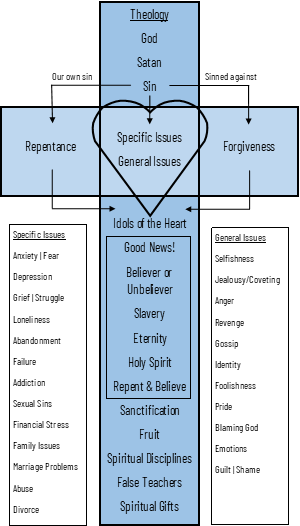
As represented in this picture of the cross, in order to find hope and healing, we will be helping our counselees identify the sin in their own life that requires repentance, and the possible need to ask others that they have harmed for forgiveness. We will also be helping our counselees identify, from their past, those who have sinned against them that they need to work to extend forgiveness. See Repentance | Forgiveness for more on this.