“Hub Resource” Introduction
The Hub Resource was constructed to equip you, in biblical counseling and discipleship relationships, to more effectively minister to those under your care. It is meant to help you identify and gain a basic understanding of many of the various issues and topics that will come up as you counsel. This resource points you to relevant stories and verses from the Bible to help you provide effective, accurate, and thorough advice. It also suggests questions to ask your counselee, things to “put off” and “put on” in relation to their sin and their struggles, and provides resources for further and deeper study, for either you or your counselee.
This resource can be used as a quick-reference guide when a topic surfaces during a meeting with someone or to help you prepare for an upcoming meeting when you have the time to prepare and understand the issue(s) at hand. In a traditional counseling scenario, you are preparing a message for your counselee each week—a message that will be prepared and delivered specifically for them; a message that will be interactive and will involve as much listening and learning as teaching. This material is designed to aid you in preparing for each one of your counseling sessions. This material will also be helpful in designing homework for your counselee each week. Homework will involve, among other activities: Bible stories to study; verses to read and meditate on; Scriptures to memorize; and books, or other resources, to read, listen to, or watch.
While this resource will be very helpful, you want to be aware of presenting the material verbatim or getting in the habit of just rattling off verses. Biblical counseling requires wisdom and an understanding of each individual you are working with in order to apply biblical truth in a way your counselee understands and in a way that relates to their individual situation. Biblical counseling requires a healthy combination of grace and truth, talking and listening, compassion and tough love, counsel and care.
To make this resource even more valuable and practical, here is a 15-week curriculum for you to work through with your counselee.
This resource is organized around four main sections:
Philosophy of Biblical Counseling—learning the what, how, and why of biblical counseling
Theology in Counseling—incorporating the theologies of God, Satan, sin, salvation, and sanctification into your counseling
Specific Counseling Topics—navigating the main issues or problems you will help solve with your counselee
General Counseling Topics—navigating the secondary issues that will surface as you work through your counseling cases
The first section, Philosophy of Biblical Counseling, is intended for you to gain a deeper understanding of biblical counseling, the philosophy of the Biblical Counseling Hub, and how to apply this resource to counseling situations.
Sections 2-4 are intended to prepare and equip you for effective counseling cases.
Each of these four sections includes multiple topics—each topic its own page—that you can access from the resource home page (click link to see all of the topics) or from links in the individual pages. Each of the specific and general counseling-topic pages (sections 3 and 4) has a section of “putting off” and “putting on,” from Ephesians 4:22-24. We will work with our counselees to put off: Satan, temptation, sin, slavery, false teachers, idols, selfishness, anger, gossip, foolishness, pride, blaming God, guilt and shame, etc.; and put on: God, Jesus, Holy Spirit, eternity, repentance, sanctification, fruit, spiritual disciplines, identity in Christ, healthy emotions, spiritual gifts, etc. Each of these topics will help you effectively guide your counselee toward truth and freedom.
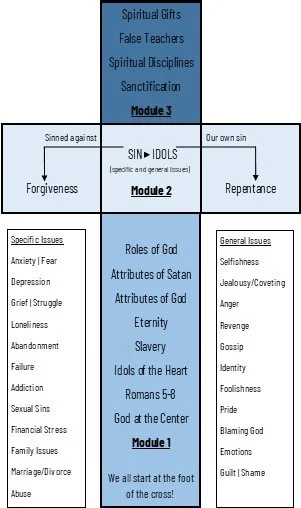
Here is a visual of how to work through the material in sections 2-4. In a traditional counseling scenario, our counselees will usually come to us with an issue or a problem they would like us to help them solve—often one of the specific topics listed below combined with one or more of the general topics. In more of a discipleship context, we will often start with the theology topics and identify encumbrances as we continue to meet. Our role as biblical counselors is to point them to the cross of Christ and the Word of God. Almost always, these issues, problems, or encumbrances will be a result of sin—either their own sin or someone sinning against them. You will help them understand that their own sin requires repentance while another’s sin against them requires forgiveness. This union of sin, their issue(s), repentance, and forgiveness is captured in the horizontal section of the cross. Gaining victory over their issue(s) or encumbrances, as well as the ability to repent of and forgive sin, requires the healing power of the Gospel and ongoing sanctification, captured in the vertical section of the cross.